
It was great to be back at Leeds Grand Theatre and Opera House, to give it its Sunday name. The place looked better for its fettling, as we say in this part of the world, having had a nip and tuck rather than the full Cher. Just as well really, as this opera provides more than its fair share of humorous moments so I didn’t want any strain put on a drum tight facelift.
The first thing to say about this opera is that there is a combination of singing and spoken dialogue which, although all performed in English, was displayed on screens at the side of the stage, thus helping at a few points in the production where complexity of the music or the volume of the orchestra in relation to that of the singer, meant that the nuances were not lost. Rest assured, in all other aspects Mozart’s masterpiece was just as bonkers as the vast majority of works in this genre.
The story is pretty straightforward in that Tamino, a handsome prince, lost in a strange land, is being chased by a huge serpent and finds himself in the palace of the Queen of the Night, more specifically in a young girl’s bedroom. That is the case for the defence, Your Honour. The pair are joined by three women who seem to be a cross between nurses, who have just dealt with a rather gory incident in A&E, and Ghostbusters. Their uniforms accommodate holsters on the back from which they produce light sabres in order to see off the monster, which they do successfully.
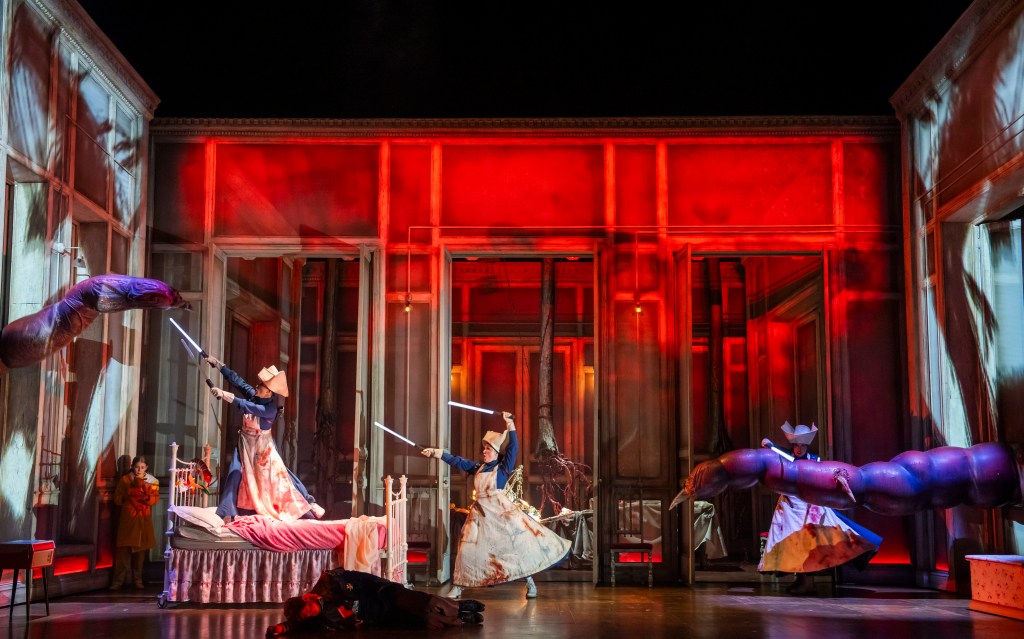
Once the snake has been pronounced deceased, the women produce a portrait of a beautiful young woman who is the Queen of the Night’s daughter, Pamina, and show it to Tamino. He is told that she is being held against her will by the evil Sarastro, Priest of the Sun, in his distant temple. Naturally his brains move about three feet south and he vows to rescue her. They give him a magic flute to assist in his quest – obviously, and, along with the local bird catcher, Papageno, he goes to the temple where he meets Pamina for the first time.
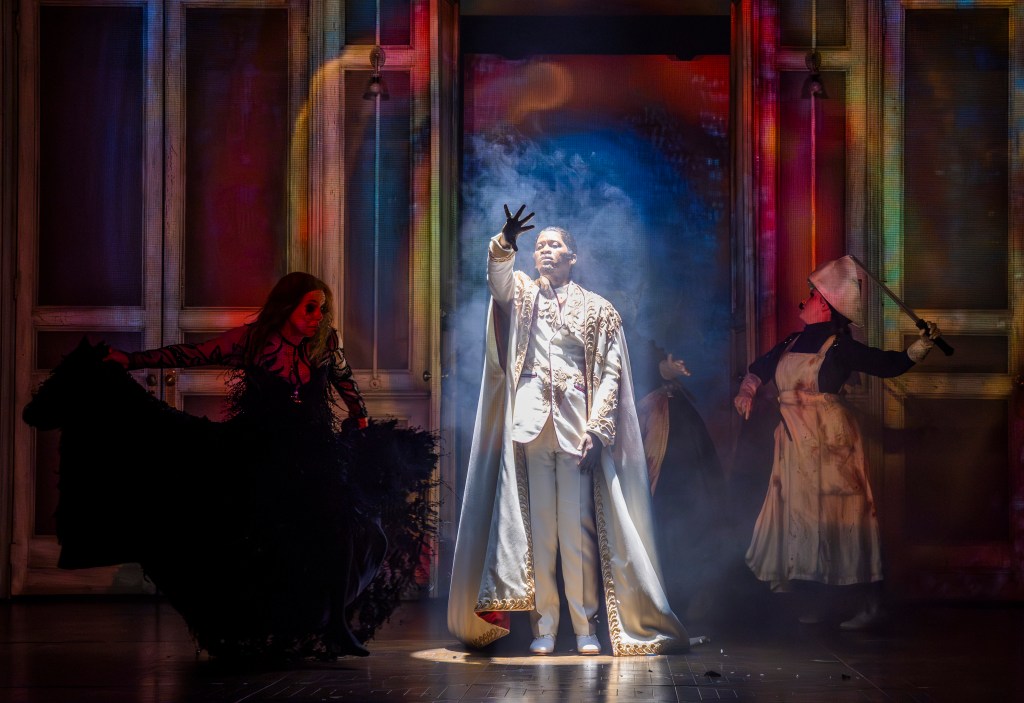
Having arrived, he realises that it is not Sarastro who is the evil one, but the Queen of the Night – I would have thought that the name was a give-away, but what do I know – and he is only sheltering her from her mother. Obviously, anyone with connections to the Queen of the Night is regarded as suspect by the Priest of Light so, to make sure Tamino is earnest in his feelings for Pamina, he sets him a series of tasks.
Using the magic flute, the prospective lovers overcome the trials and earn the right to be with each other. Just as it looks as though everything will end happily ever after, the Queen of the Night rocks up with her servants to storm and destroy the temple, but Sarastro appears and he and his followers defeat them. The sun rises on the lovers and then it does end happily ever after.
The story, however, is only a part of the opera, there is a great deal of character exploring which brings the piece alive. It is also one of the few ‘comic’ operas which has made me laugh, let alone smile. They are usually too daft to be funny, but here we have a depth which has been plumbed to add wit. Admittedly, the thought of magic talismans is a bit far fetched but is more than offset by the other elements.
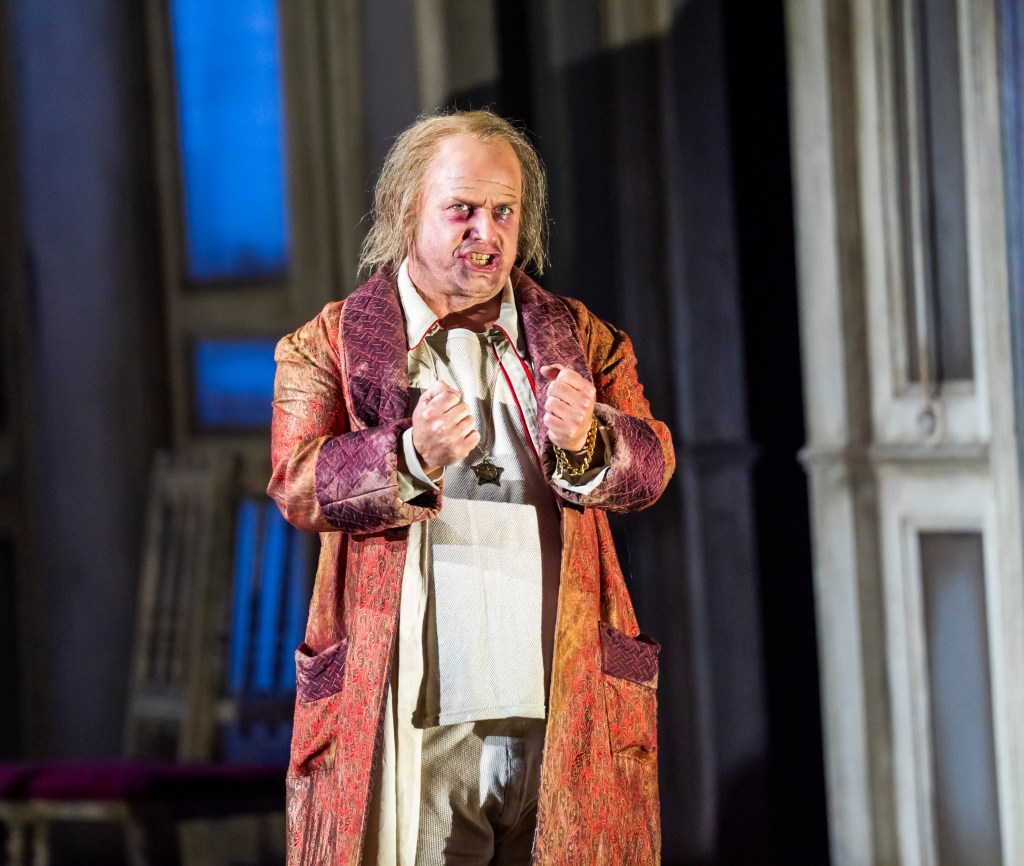
I don’t know whether it is these strange times in which we live that affected my view of some of the scenes, but a couple of episodes seemed quite creepy. The opening sees a (very) young girl in her bedroom, with a party going on in the dining room behind a mesh semi-transparent curtain. The revellers seem to be members of an organisation akin to the Bullingham Club with well-to-do young men in evening dress, drinking and cavorting, eventually spilling over into the chamber where the girl and her nanny are ensconced. After making a nuisance of themselves for a while, they begin to leave with only an older, balding, rotund elderly man remaining. He approaches the bed and amuses the girl by playing with her toys. Later in the work this same character, Monostatos, is seen in Sarastro’s temple trying to force himself on Pamina a couple of times, once by climbing onto her bed despite her protestations. His appearance and modus operandi brought to mind the alleged activities of a deceased former department store owner. The singer playing this role, Colin Judson, attracted a chorus of pantomime villain boos at the curtain call, although I got the sense that, in view of the nature of his offences, they were a bit muted so as not to make light of them. Thankfully, neither of his advances came to anything but only due to timely interventions by others.. The young men in the first scenario were seen, shortly thereafter, back in the dining room with their significant others.
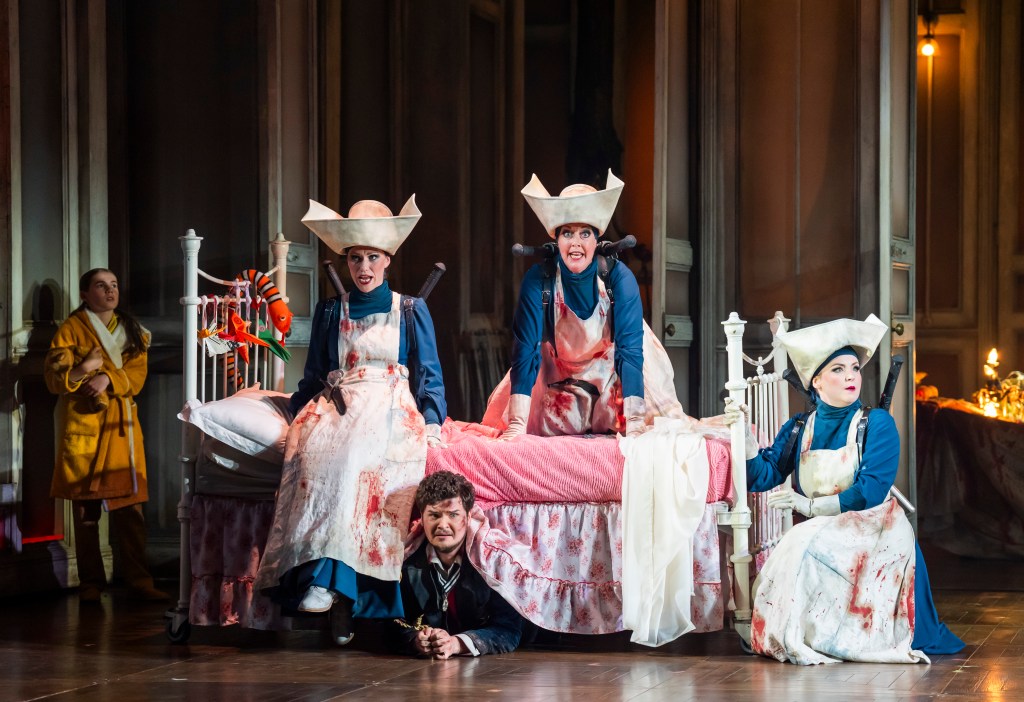
The three monster-slaying women, sung by Charlie Drummond, Katie Sharpe and Hazel Croft, were very funny, especially in their gender reversal aims which were similar to those of the aforementioned Monosantos, although much more restrained. When they had dispatched the serpent they argued as to which one of them should stay and comfort Tamino, as he seemed the worse for wear. The discussion became quite heated as all three of them fancied him. The more the temperature raised, the funnier the acting and singing became. They appeared later in an equally hilarious scene.
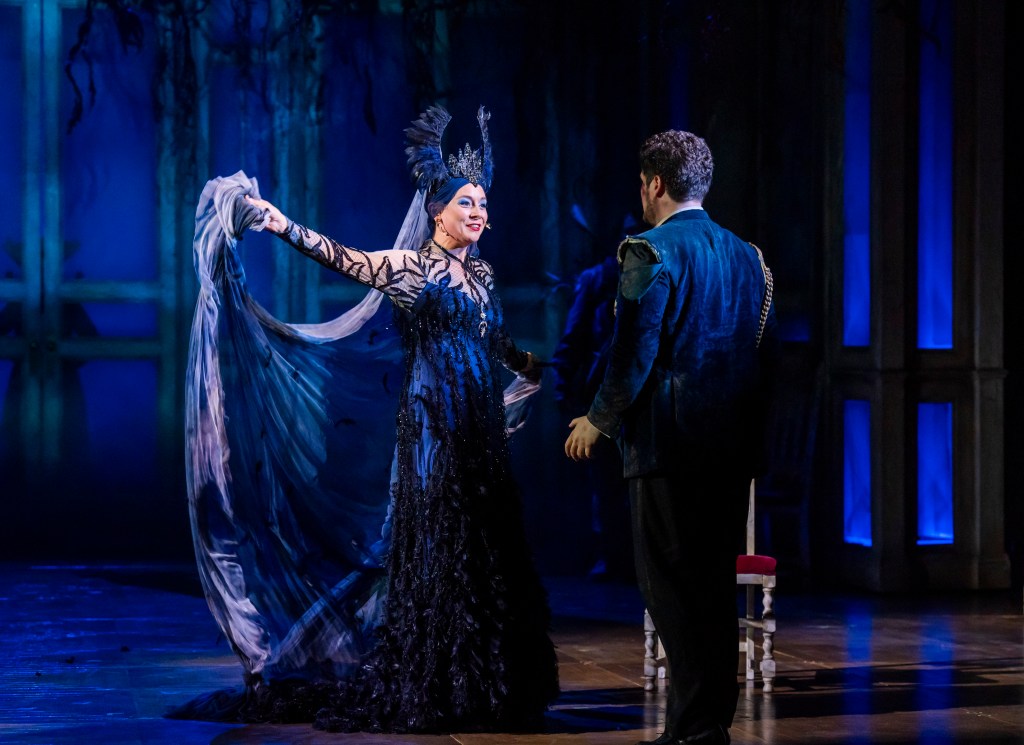
The Queen of the Night, Anna Dennis, was so menacing as to make you wonder why Tamino, Egor Zhuravskii, didn’t suss her out from the start, but I suppose that would have made for a very short opera. Both of their roles were carried off to perfection in both the singing and acting disciplines. The only singer I found to be somewhat disappointing was Msimelelo Mbali who sang the role of Sarastro. He is listed on various websites as a bass but in this role he seemed to me to be more of a baritone, in fact, on the occasions on which he lowered his register to bass, I found the volume and power dropped off a tad, meaning I needed to consult the title screens. He certainly was a commanding presence on the stage, however.

Pamina, Claire Lees, conveyed a range of emotions, from playful to suicidal, superbly well. You will be relieved to hear that three boys, who keep popping up at various intervals, talk her out of ending it all.

The show-stealer, however, is Papageno, the bird catcher, who, until his trip to Sarastro’s temple, had never left the woods, living by bartering the birds he caught with local people. Emyr Wyn Jones, who sang and acted the role, stayed just on the right side of the fine line between naivety and stupidity. Everything he did made perfect sense to him, whilst not being appropriate in most cases, such as bragging about having killed the monster himself until upbraided by the three women who had actually done the job. When he and Tamino were captured by Sarastro’s guards he confided in them that all he wanted from life was food to eat and a wife for companionship. When told that he would need to pass the same trials as Tamino to be given the latter, he asked if he could reconsider and just take the food. Having caught sight of a lovely lady in the temple, Papagena, sung by Pasquale Orchard, a member of the Chorus of Opera North, he changed his mind back. I think that his Welsh lilt had something to do with his image as, apart from being incongruous in a seemingly mid-European land far away from his forest, it had the cheeky timbre reminiscent of Max Boyce – one for the more mature readers there.
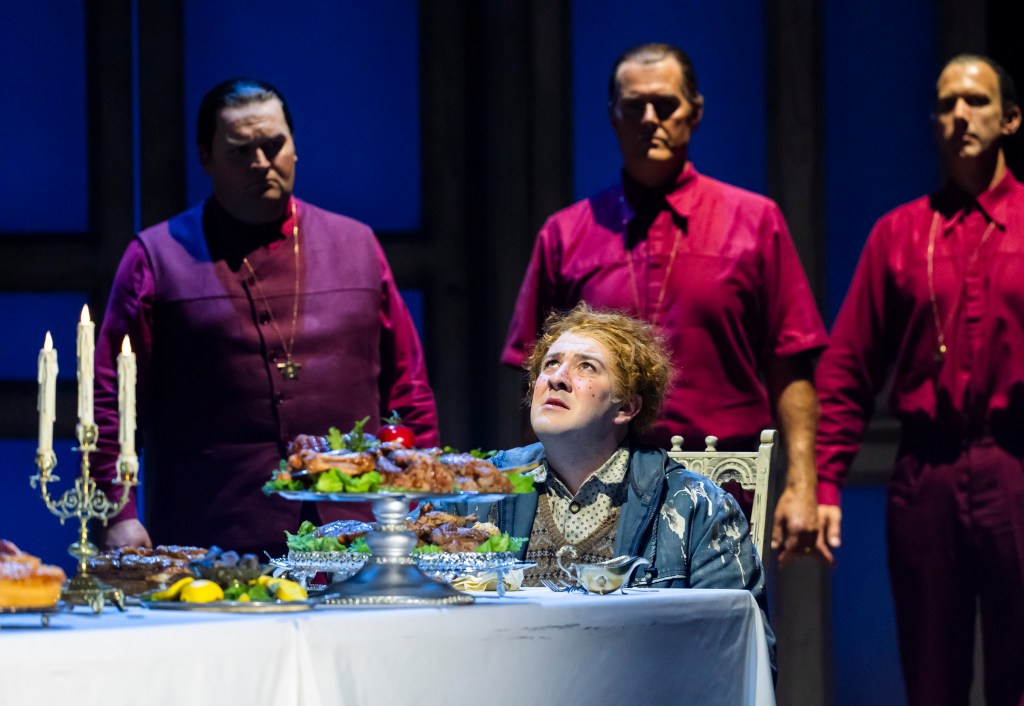
The first trial was one of silence, which was dutifully completed by Tamino, causing the depression of Pamina, who thought the Trappist-like code of conduct, meant that his attitude to her had changed. Papageno, on the other hand, continued to rabbit on about not much at all. Rather than this disqualifying him from being granted the hand of Papagena, it seemed to show the guards that he was a little too simple to pose any threat to the priest. He was thus spared the next two trials which awaited his companion. These were fire and water.
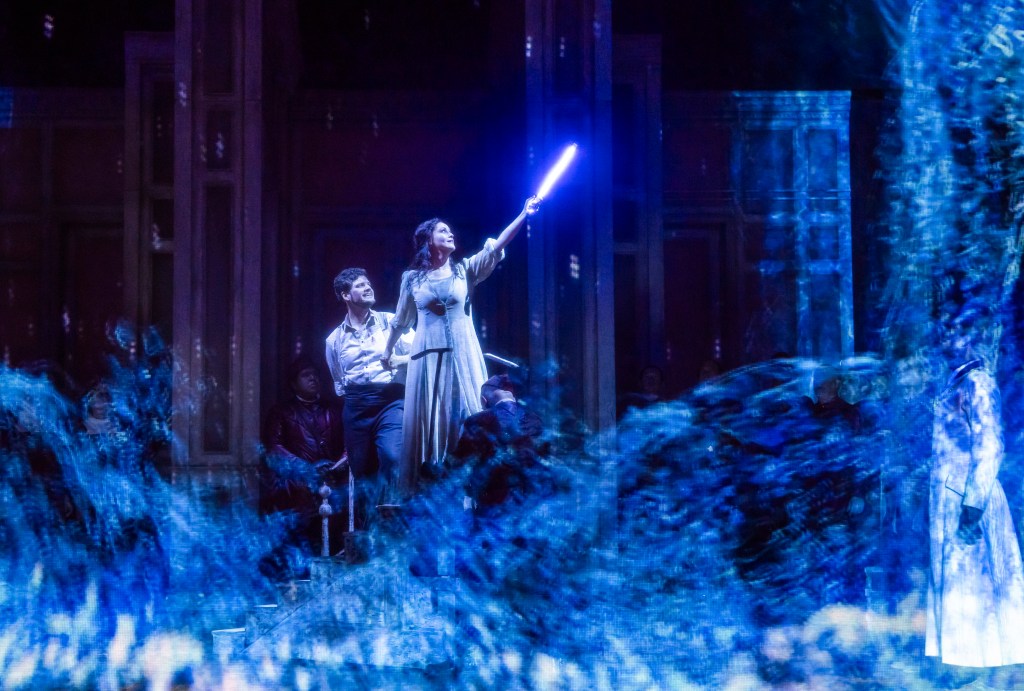
To accommodate the staging of these, the mesh curtain was lowered from the flies again and a phenomenally lifelike projection of a conflagration, followed by a deluge, displayed on it, with the characters still visible in the background. This was certainly the most impressive special effect I have seen in any opera and few other theatrical performances of any kind. Perhaps the only ones to compare are those in the legendary Leeds Playhouse Christmas Shows, which are directed by James Brinning, who, surprise, surprise, was the Director of this opera. He was aided and abetted by; Set and Costume Designer, Colin Richmond; Lighting Designer, Chris Davey; Video Designer, Douglass O’Connell and Choreographer, Tim Claydon. I feel as though the next observation is totally superfluous, but the playing of the Orchestra of Opera North, under the baton of Christopher Koncz, and the singing from the Chorus of Opera North, Chorus Master, Anthony Krauss, were both immaculate.
In the end, the magic flute of Tamino and the magic bells, given to Papageno by the three boys, see our heroes find love and redemption and the baddies meet their inevitable fate.

As you will have gathered, I thought that this was a wonderful production of a great opera and, as such, should you have never been to an opera before and be contemplating taking advantage of the Try It ON scheme, this would be a great introduction for you. Please go to https://www.operanorth.co.uk/your-visit/new-to-opera/tryiton/ for full details.
The Magic Flute is at Leeds Grand Theatre again on 5th and 11th October after which it tours to Newcastle Theatre Royal; The Lowry, Salford Quays; Theatre Royal, Nottingham before returning to Leeds in February, 2025 when does the same circuit, adding two dates at Hull New Theatre in March for good measure.
For tickets, booking and to see what else Opera North have on offer, please go to https://www.operanorth.co.uk/
All images supplied by Opera North. Photographs in text by Tristram Kenton
I like to give taster whenever possible so I thought you might be interested in this YouTube video showing an impromptu performance of the Queen of the Night aria by Anna Dennis who is in plain clothes, so looks totally different to the menacing figure on the feature image of this article. There are buskers and then there are Leeds buskers!
 Tyke It To The Limit